How to Choose a Power Bank: A Guide to Picking the Right Specs
October 27, 2026 · 10 min read
A dead phone can quickly turn a normal day into a headache.
Still, knowing how to choose a power bank takes more than just picking the highest mAh rating. Capacity matters, but so do wattage, charging input and output, ports, cable quality, fast-charging protocols, usable capacity, size, weight, device compatibility, and safety.
This portable power bank buying guide explains what to look for in a power bank without jargon. You will learn which power bank specs affect daily use, travel, and promotional gifting.
The best power bank matches your devices, routine, and charging needs.
What Is a Power Bank?
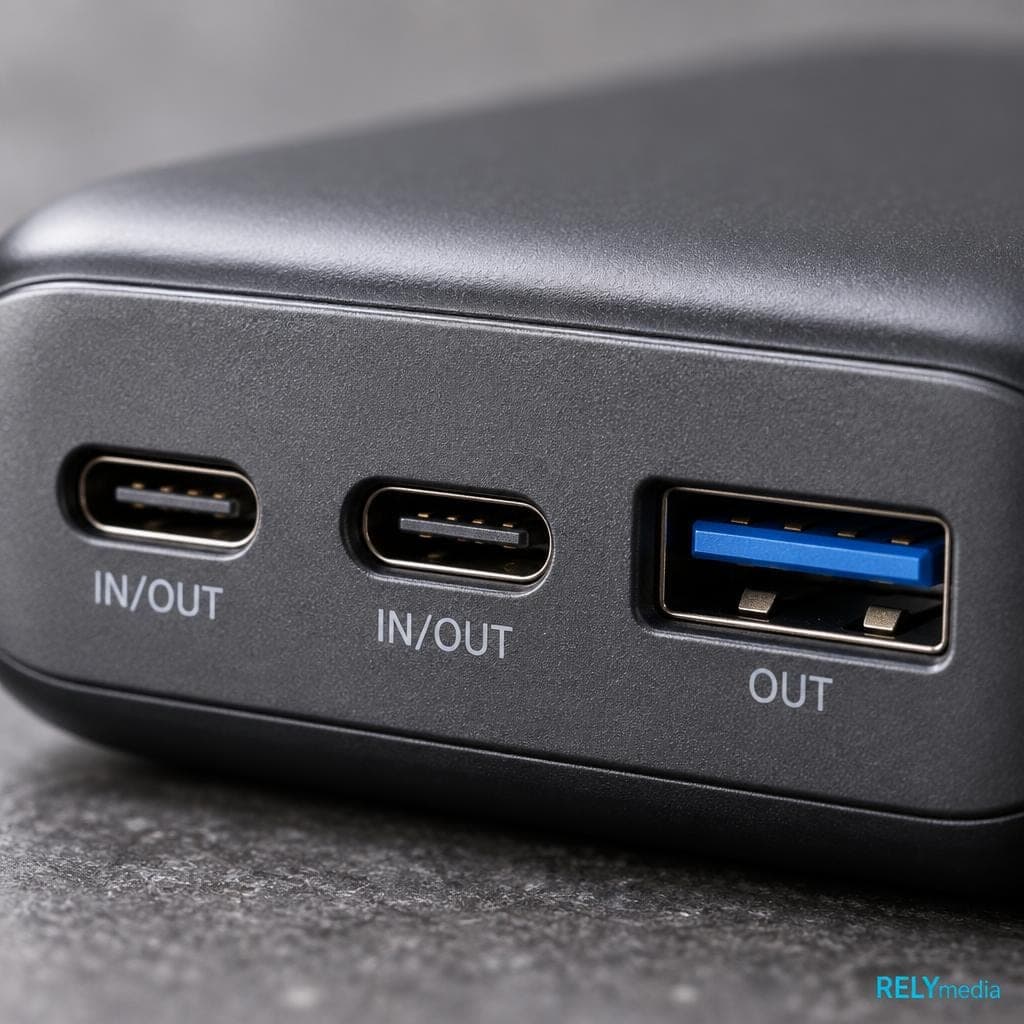
A power bank is a portable battery that stores rechargeable power for later use. Most models contain a lithium-ion battery, charging circuitry, one or more charging ports, and a battery indicator.
Connect a phone, tablet, headphones, laptop, Nintendo Switch, or another electronic device, and the battery pack supplies temporary power through USB-A, USB-C, Type-C, or wireless charging.
You may also see portable charger, backup battery, rechargeable power source, or portable battery charger.
A power bank with an outlet is intended for larger devices but usually adds to its size and weight.
Think of it as a rechargeable fuel tank. Capacity shows stored energy. Power output shows delivery speed.
How to Choose a Power Bank by Capacity
Power bank capacity is usually the first specification shoppers notice. Manufacturers list it in milliamp-hours, or mAh.
Higher capacity generally means more stored energy. It also adds weight, volume, and bulk.
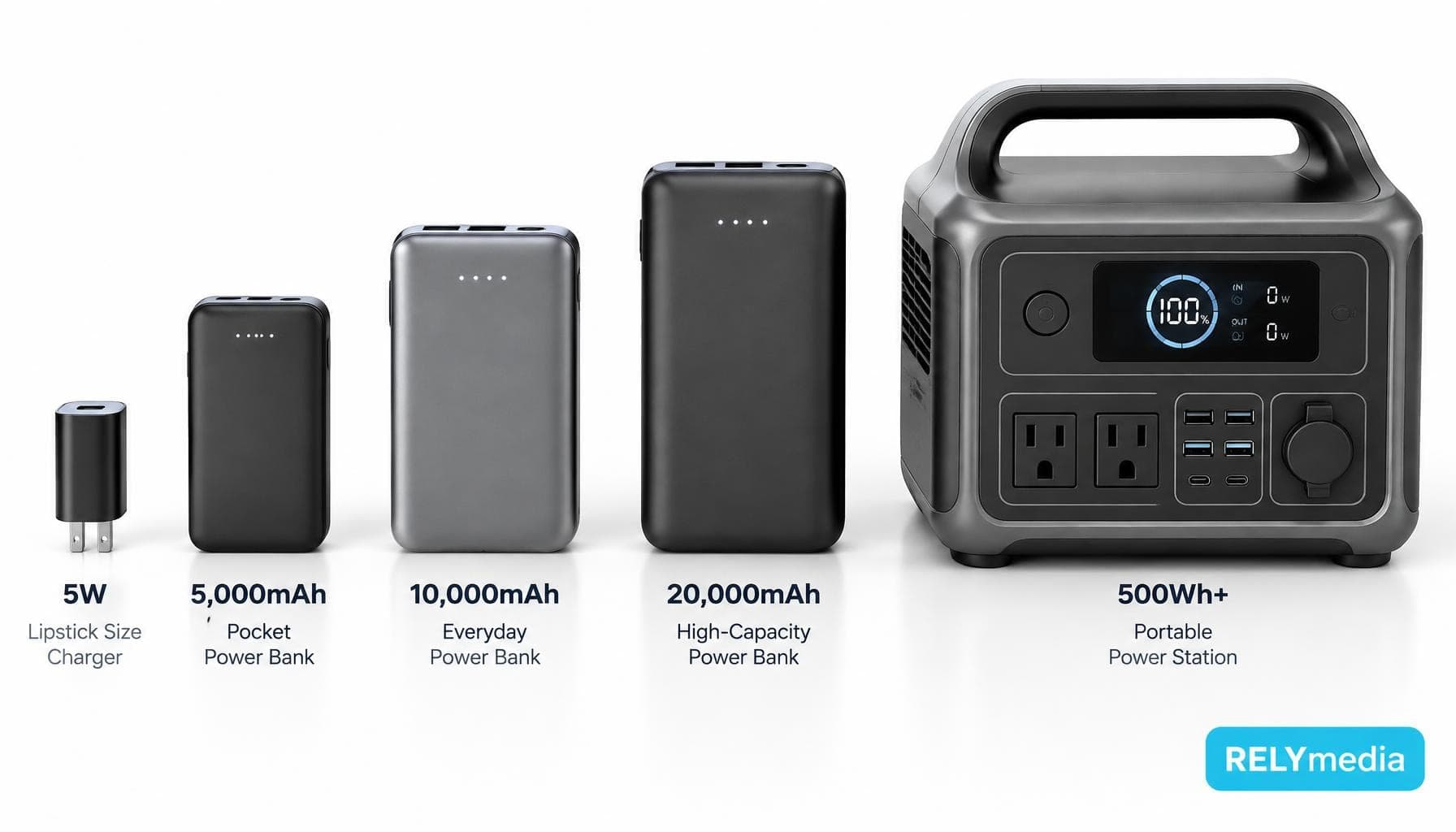
| Power Bank Capacity | Best Fit | Typical Use |
|---|---|---|
| 5,000mAh | Light daily carry | Emergency phone top-ups |
| 10,000mAh | Everyday use | Smartphones, earbuds, commuting |
| 20,000mAh | Travel use | Multiple charges and devices |
| 20,000mAh+ | Extended backup | Laptops and long trips |
What Is a Good mAh for a Power Bank?
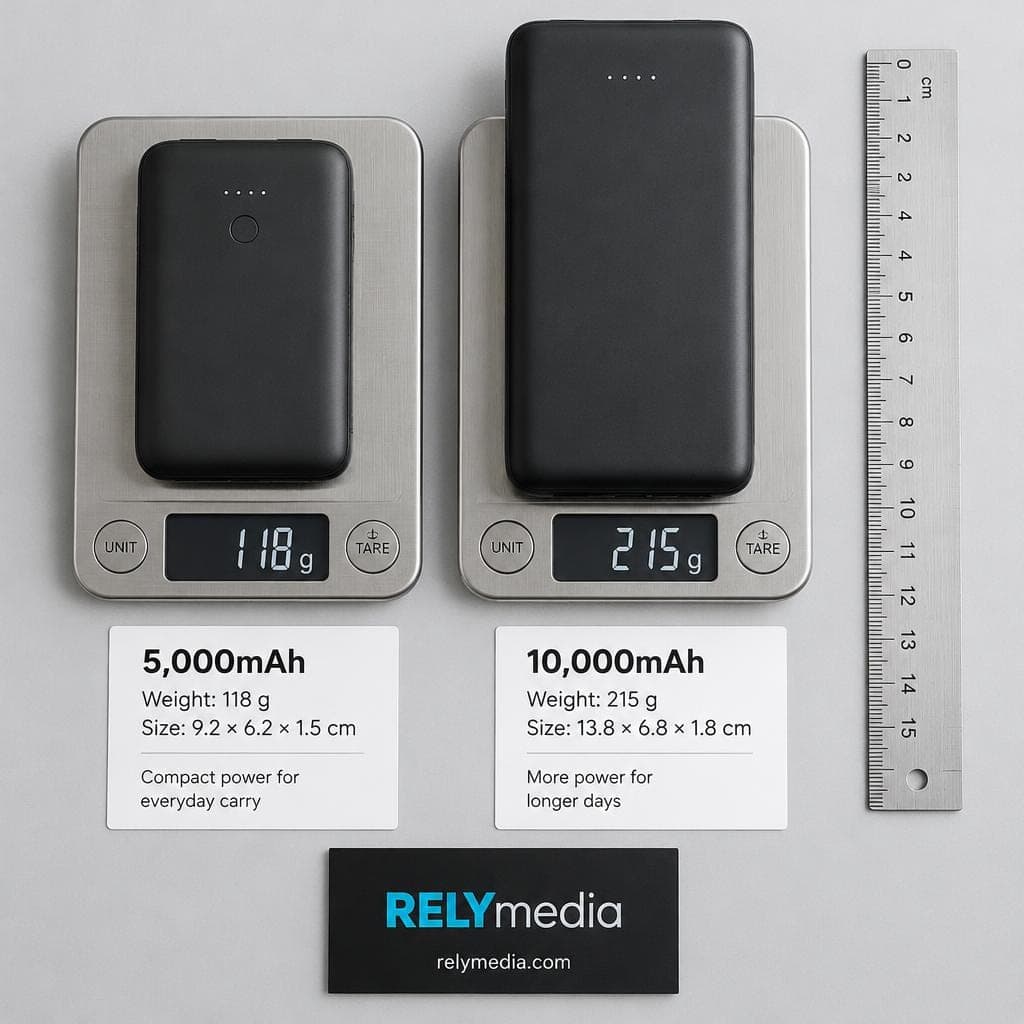
For many smartphone users, 10,000 mAh strikes a balance between charging capacity and portability. A 5,000mAh unit works well for emergency power. A 20,000mAh model is ideal for long trips, multiple charges, and multiple devices.
If you are asking what size power bank you need, start with your routine. A commuter needs less capacity than a traveler charging several devices.
5,000mAh vs. 10,000mAh
The 5000 mah vs 10000 mah decision comes down to convenience versus reserve power.
Choose 5,000mAh when pocket size matters most. Choose 10,000mAh when you want more battery backup without carrying a high-capacity unit.
These power bank sizes cover many users. Larger models suit laptops, frequent travel, or extended backup.
Battery Capacity, Rated Capacity, and Usable Capacity
Stated capacity is the battery rating printed on the product. Rated capacity and usable capacity describe how much energy becomes available after real-world conversion losses.
Conversion loss, cable loss, heat, and other charging losses reduce delivery. A 10,000mAh power bank cannot deliver its full capacity to your phone.
Why Watt-Hours Matter
Watt-hours, or Wh, describe total energy more directly. They matter especially for laptop charging and airline travel.
Use this simple calculation:
Wh = Ah × voltage
A 10,000mAh battery equals 10Ah. At a nominal voltage of 3.7V, it stores about 37 Wh.
How Much Watt Power Bank Is Good for Mobile Phone Use?
Capacity tells you how long stored energy may last. Wattage indicates how much power can flow.
For many smartphones, 18W to 30W covers common fast charging needs. Tablets and laptops may require more.
Check the device maker’s requirements. A 100W power bank does not force 100W into a phone that supports less.
USB Power Delivery can support up to 240W on compatible USB-C hardware and cables. Not every USB-C power bank or cable supports that level.
Capacity and Wattage Are Different Power Bank Specs
A high-capacity model with weak output may charge a laptop too slowly. A compact high-output model may charge quickly but offer fewer total charges.
When deciding which power bank is better, compare both numbers.
Fast Charging, Power Delivery, and Quick Charge
Fast charging works only when the device, cable, power adapter, and charging protocol work together.
USB Power Delivery, or PD, uses USB-C to negotiate power. Quick Charge, or QC, is Qualcomm’s fast charging standard used by many Android devices.
USB-A vs. USB-C
USB-A remains useful for older equipment. USB-C offers a reversible connector and can support higher charging output when the hardware allows it.
Check whether a USB-C charging port supports charging input, output, or both. Two-way or bidirectional charging lets one port recharge the portable battery and power another device.
What to Look for in Power Bank Specs and Ports
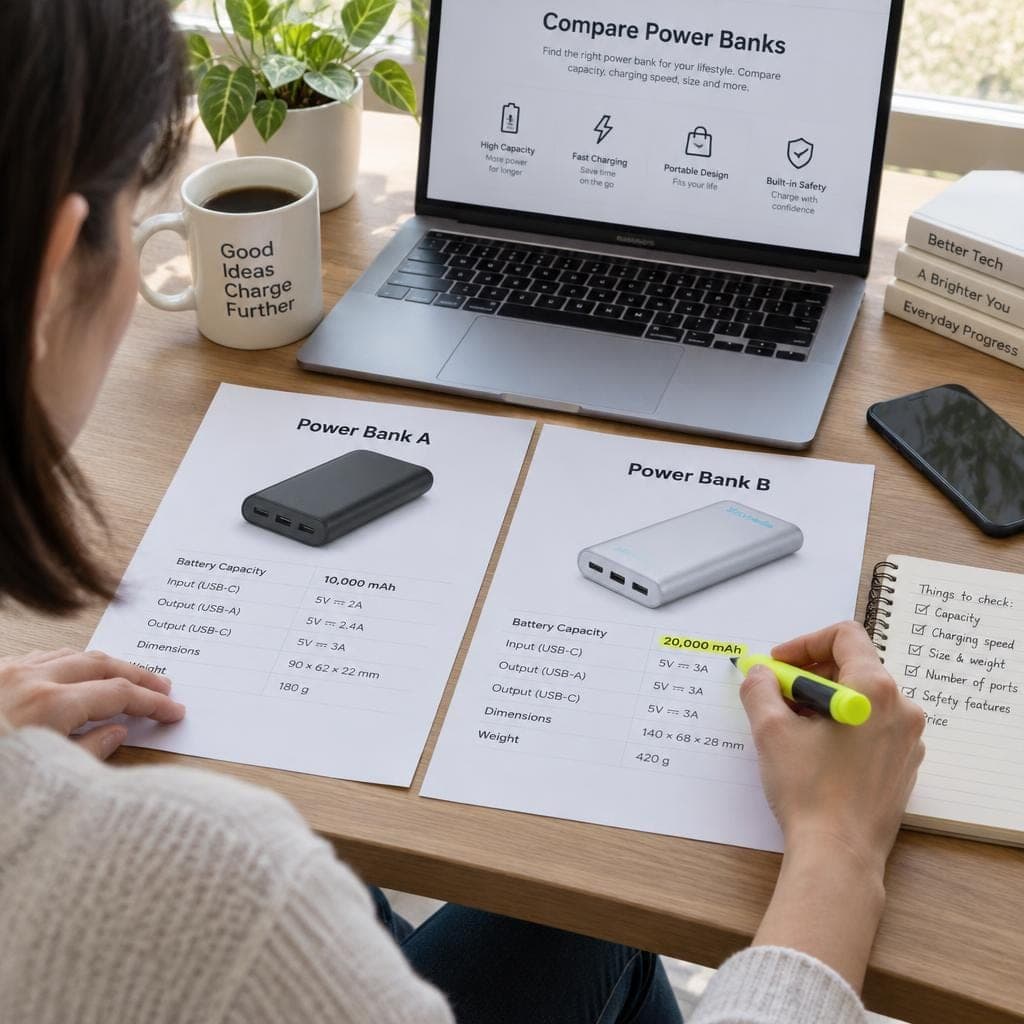
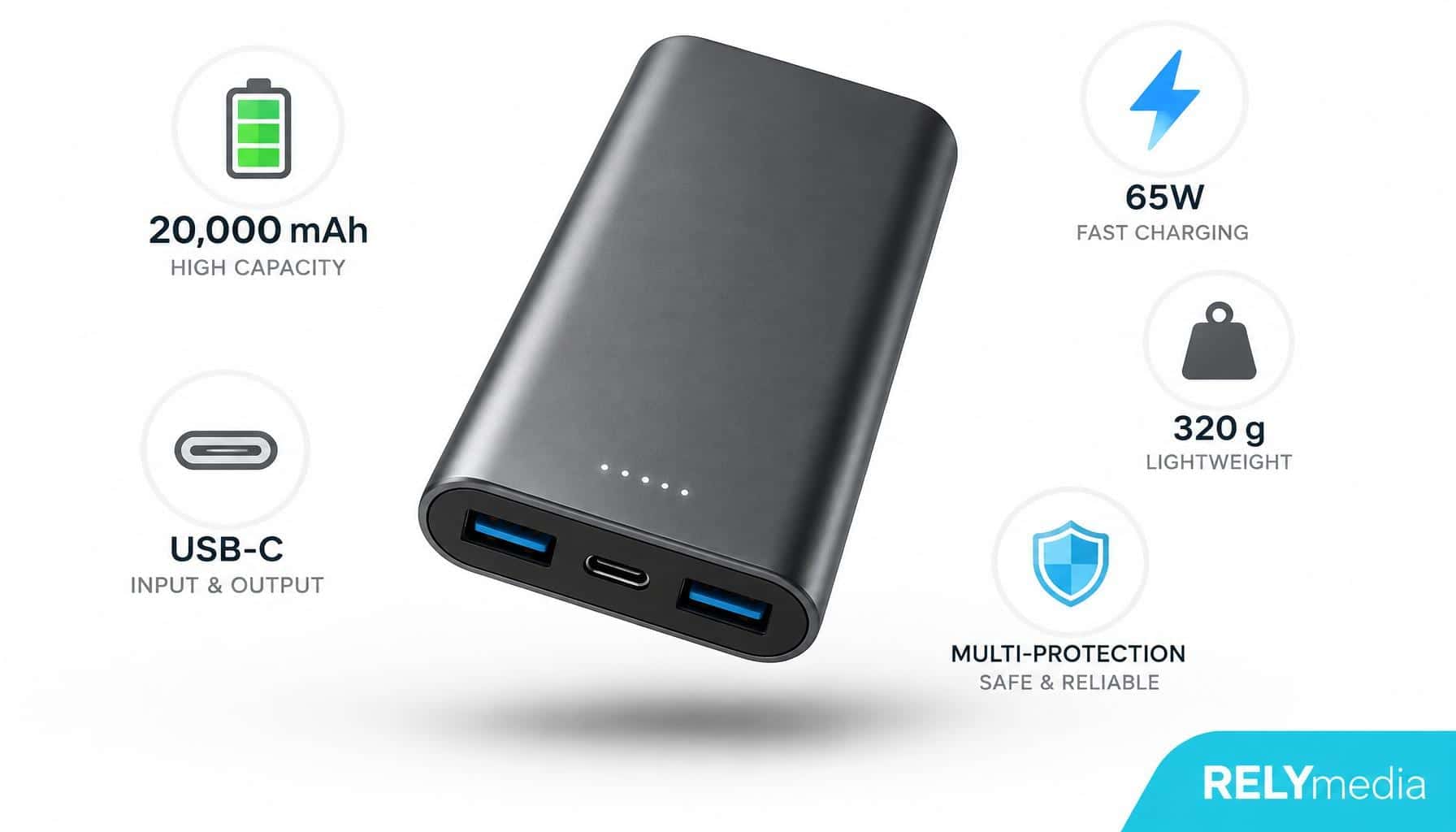
If you are wondering what to look for in power bank specs, focus on numbers that affect real use:
- Maximum power output
- Per-port charging output
- Charging input
- Number of output ports
- USB-A and USB-C support
- PD or QC compatibility
- Simultaneous charging behavior
- Included USB cable
- Battery level indicator
- Device compatibility
A 65W label may describe one port only. During multiple-device charging, total power may be shared.
This is an important consideration when buying a portable phone charger because headline numbers rarely tell the whole story.
Your Charging Cable Matters
A fast-charging cable forms part of the charging system. An under-rated cable can limit charging speed even when the charger and power bank support higher wattage.
For high-power USB-C charging, confirm the cable supports the required wattage.
Match the cable, connector, and output to the devices your promotional product recipients actually use.
Wired vs. Wireless Charging
Wired charging usually provides better charging efficiency and faster power transfer. Wireless charging trades some efficiency for convenience.
Qi and Qi2 help compatible devices and chargers work together. Magnetic alignment can simplify wireless charging by ensuring the device is positioned correctly.
When deciding what to look for in a portable charger, choose wireless charging only when it solves a real need.
How Many Times Can a Power Bank Charge a Phone?
A charging formula can estimate the number of charges, but simple mAh division usually overstates real performance.
Consider usable capacity, conversion efficiency, cable losses, device battery capacity, heat, charging speed, and phone use during charging.
For example, a 10,000mAh unit will not deliver its full stated capacity to a 5,000mAh phone battery. Conversion and charging losses reduce usable energy.
Power Bank Size, Weight, and Portability
A compact power bank works well for daily carry. A larger capacity provides more backup power but adds weight and volume.
When learning how to pick a power bank, ask whether you will actually carry it. A huge battery at home does little good during a dead-phone emergency.
Tips for Choosing Rugged Portable Battery Packs
Outdoor users should look for durable housing, protected ports, clear environmental ratings, reliable battery protection, and practical weight.
Never assume rugged styling means waterproofing. Check the rating.
Choose branded power banks people will keep using. Useful promotional items create repeated brand exposure.
Power Bank Safety and Product Certification
Safe charging matters as much as charging speed. Look for protection against overcharging, over-discharge, short circuits, overload, and excessive heat.
UL 2056 specifically addresses power bank safety testing, including overcharge, discharge, short-circuit, impact, overload, and thermal concerns.
FCC, CE, BSMI, and other markings can address different requirements. Do not treat every logo as equivalent battery safety certification.
Stop using a battery pack if you notice swelling, unusual heat, damaged ports, a cracked case, or strange odors.
Can You Take a Power Bank on a Plane?
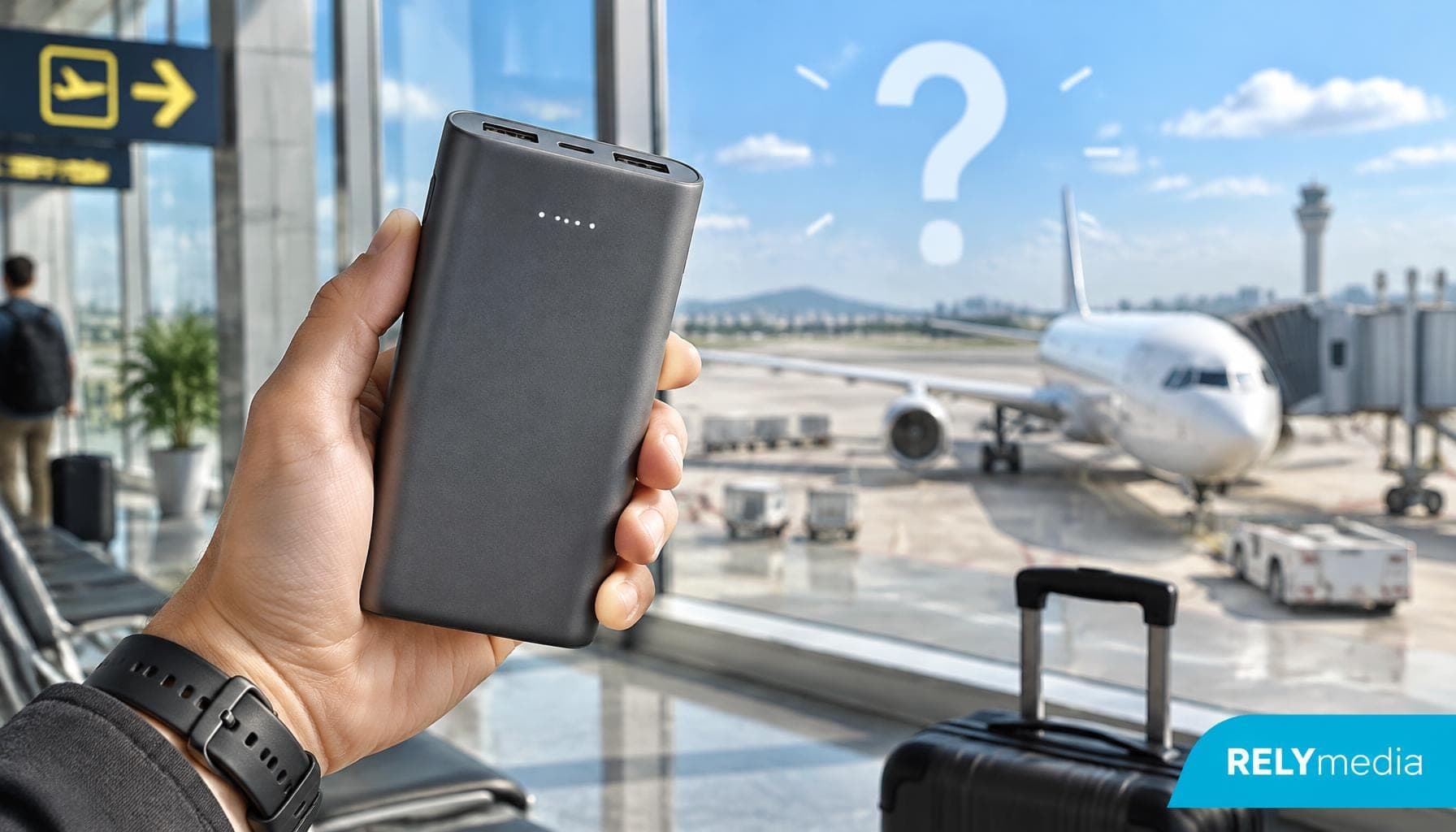
For US air travel, spare lithium batteries and power banks belong in carry-on baggage rather than checked baggage.
Rechargeable batteries up to 100 Wh generally fall within standard passenger limits. Batteries from 101Wh to 160Wh require airline approval. Larger batteries face stricter restrictions.
Airlines can add rules, so check before departure.
How Long Does a Power Bank Take to Recharge?
Charging time depends on battery capacity, charger power, charging input, cable capability, and charging technology.
Older 5V/2A chargers can recharge a high-capacity power bank more slowly than USB-C fast chargers.
Look at input wattage as carefully as output. A unit may charge your phone quickly yet recharge itself slowly.
Some models support pass-through charging. Use that feature only when the manufacturer officially supports it.
Power Bank Battery Lifespan and Maintenance
Good battery care can slow battery degradation and support a longer battery lifespan.
- Avoid high temperatures and direct sunlight.
- Never leave a battery pack in a hot vehicle.
- Keep it away from excessive humidity.
- Avoid repeated complete discharge when practical.
- Use a qualified charger and stable power source.
- Check stored batteries periodically.
- Stop using damaged or swollen units.
Modern lithium batteries do not need battery stabilization. Follow the manufacturer’s charging instructions.
Need dependable branded technology on a deadline?
Contact RELYmedia for product guidance, proofs, branding, and fulfillment support.
How to Choose a Portable Charger for Promotional Use
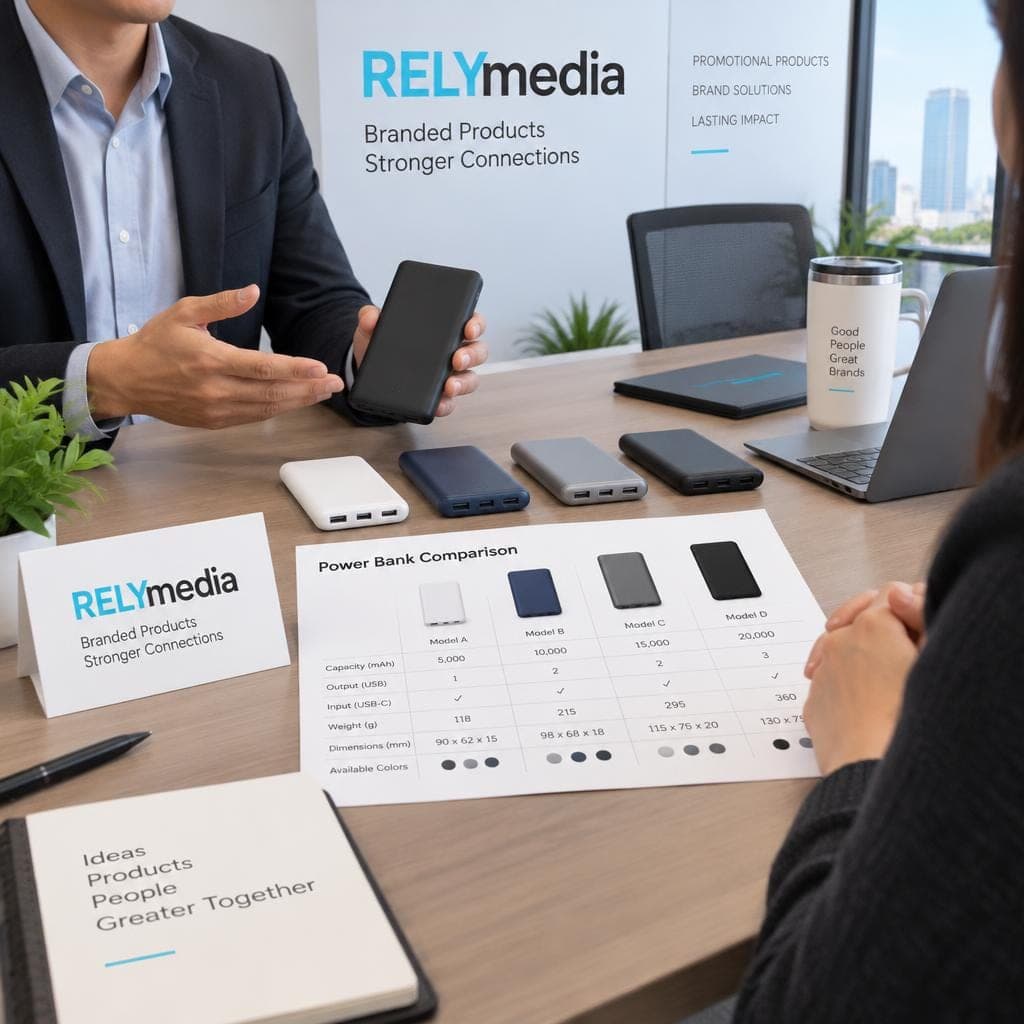
A promotional charger should remain useful after the event ends. That makes product selection part of your branding strategy.
Match the item to the recipient. Conference attendees may prefer compact models, while travelers may value larger capacity and fast charging.
Also review imprint area, finish, packaging, charging cable, device support, and durability.
RELYmedia helps organizations choose promotional products around real budgets, deadlines, branding needs, and distribution requirements.
Power Bank Buying Checklist
Before buying, confirm:
- Power bank capacity and usable capacity
- Watt-hours
- Maximum and per-port output
- Charging input
- USB-A or USB-C ports
- Power Delivery or Quick Charge
- Device support
- Cable requirements
- Wireless charging needs
- Simultaneous charging
- Power bank size and weight
- Battery protection
- Relevant product certification
- Airline suitability
- Warranty and support
This checklist covers what to look for when buying a power bank without turning every feature into a must-have.
Ready to print your team's name on premium apparel?
Fill in your details and a RELYmedia specialist will come back to you with a custom quote — fast turnaround, no obligation.
- ⚡Same-day response on business days
- 🎨Free design assistance included
- 🚚Rush order & fast delivery available
- 💰Price beat guarantee on every order
Shop custom power banks and chargers
See all power banks & charging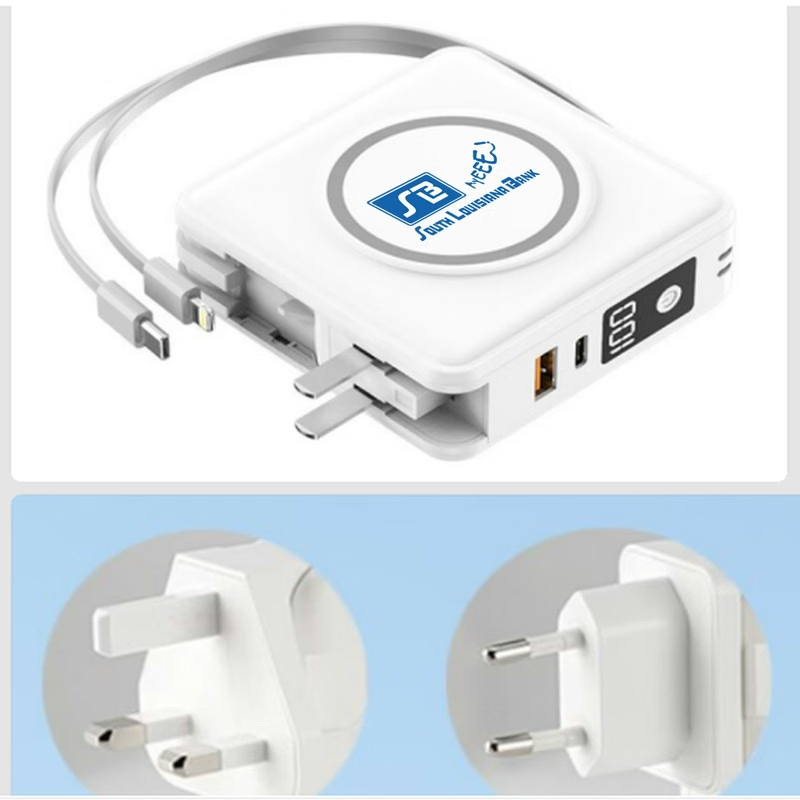
10,000 mAh Wireless Fast Charging Power Bank and 5IN1 Travel Charger w/Intl
$48.25 - $53.66
View product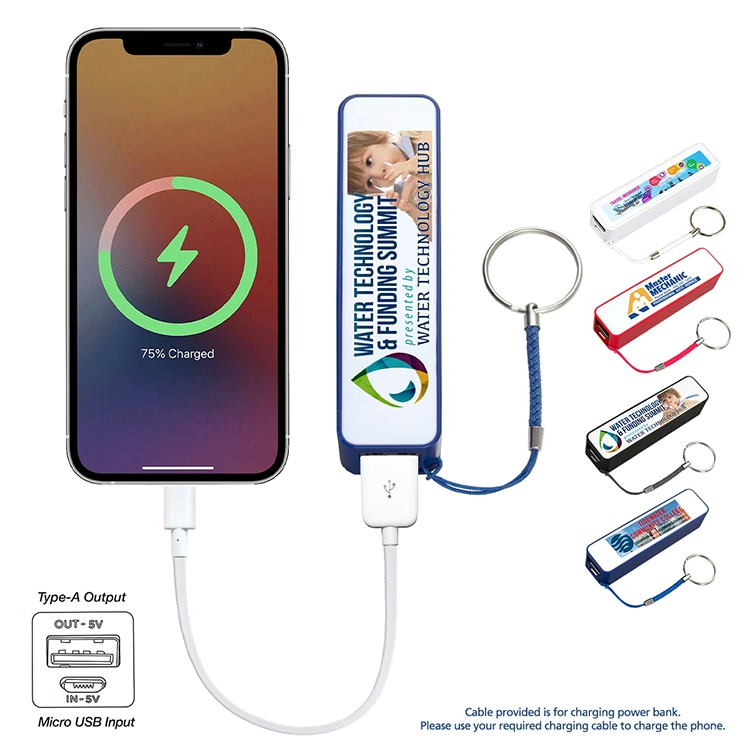
In Charge PB200 UL Listed 2200 mAh Portable Lithium Ion Power Bank Charger PB1004
$7.03 - $7.91
View product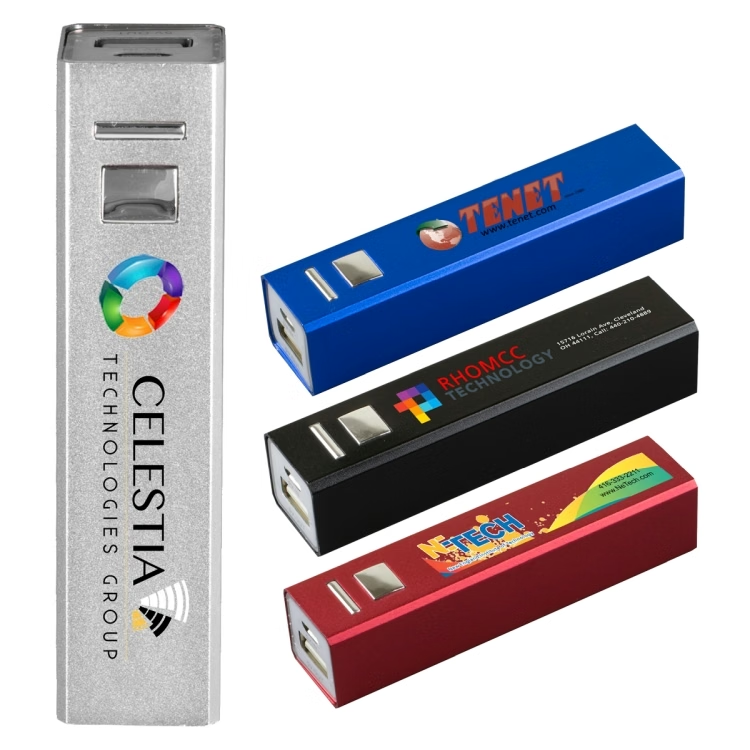
In Charge Alloy UL Listed Aluminium 2200 mAh Lithium Ion Portable Power Bank Charger
$7.57 - $8.85
View product10,000 mAh Energizer® Mag-N-Kick™ Wireless Charger Power Bank And Phone Stand
$34.39 - $52.31
View product10,000 mAh Wireless Charger Power Bank
$25.59 - $44.77
View product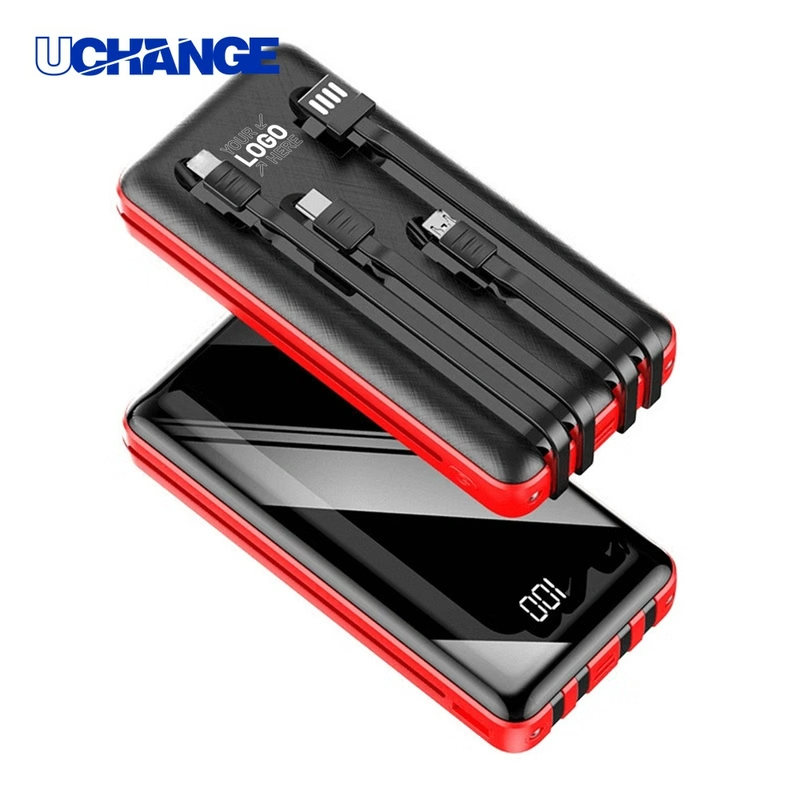
10,000mAh Portable Charger Power Bank with Dual Flashlight
$7.63 - $12.53
View product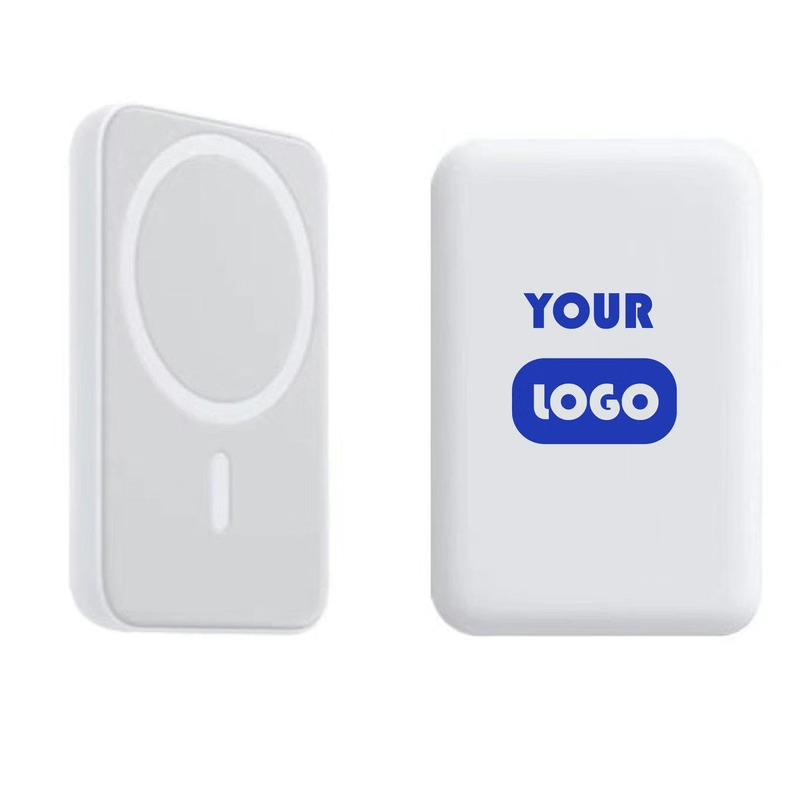
10,000 mAh Wireless Charging Power Bank
$11.58 - $25.35
View product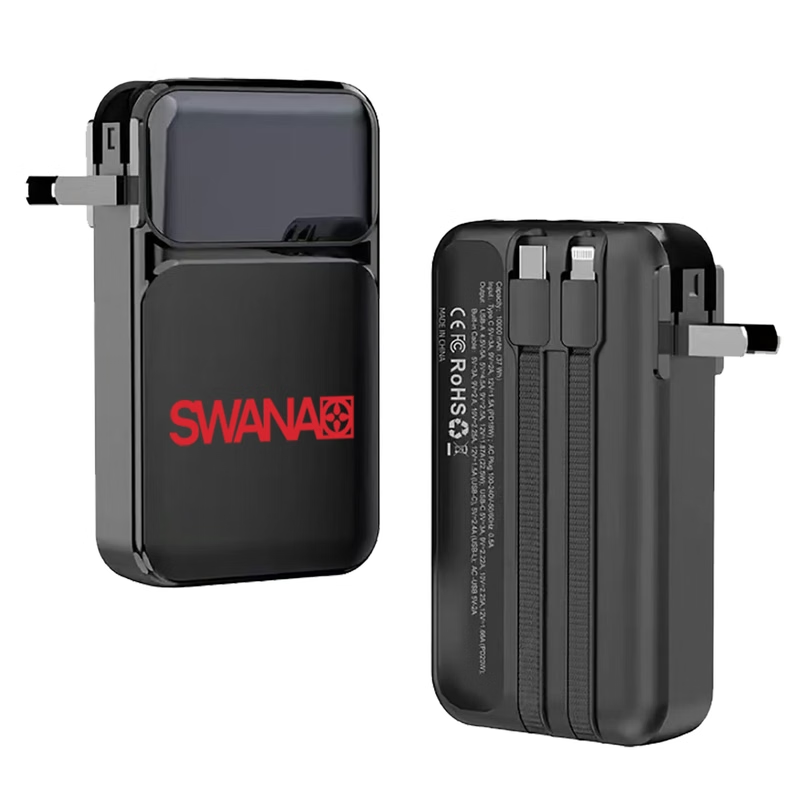
10,000 mAh Portable Charger w/Built In Wall Plug Power Bank
$27.43 - $32.36
View product
Frequently Asked Questions About Power Bank Specifications
What Should I Look for in a Power Bank?
Focus on capacity, wattage, charging protocol, ports, charging input, size, safety, and device compatibility.
How Do I Choose a Power Bank Charger?
Match the charger output and charging standard to the power bank’s supported input. A higher-rated adapter helps only when the power bank can accept that power.
Can a Power Bank Charge a Laptop?
Yes, if the laptop and power bank support compatible USB-C Power Delivery and sufficient wattage.
Can I Charge Multiple Devices at Once?
Yes, on models with multiple output ports. Check whether total power is shared.
What Should I Look for in a Portable Battery Charger?
Prioritize safe charging, useful capacity, adequate wattage, compatible ports, reasonable weight, and clear product documentation.
Conclusion
Knowing how to choose a power bank becomes easier once you separate capacity from charging speed.
Start with the devices you carry. Then compare power bank capacity, usable energy, wattage, charging input, ports, protocols, cable requirements, size, and safety.
For everyday phone charging, portability may matter most. For long trips, capacity and watt-hours become more important. For laptops, sufficient USB-C PD output and a capable cable matter greatly.
The same logic applies to promotional chargers. A branded power bank should be useful, reliable, and appropriate for the recipients.
RELYmedia helps businesses and organizations turn practical charging products into branded tools people can use repeatedly. That means matching the product to your audience, budget, deadline, and brand.
Ready to choose a power bank people will actually use?
Contact RELYmedia for custom options built around your campaign and recipients.
Shop this
Need custom power banks? We print them.
Bulk pricing, three free mockups, real quotes back the same business day.