Screen Printing T-Shirts: How It Works, Inks, Mesh Counts and Costs
April 3, 2026 · 9 min read
Screen printing is still the usual choice for team, event and company shirts in quantity. It gives solid, opaque color and a low price per shirt once the screens are made. It is not always the right choice, though: for a handful of shirts or a full color photo, DTF or DTG is often cheaper and simpler.
This guide covers how the process works, which inks and mesh counts printers use, how it compares with DTF, DTG and sublimation, and what changes the price.
By the RELYmedia editorial team · Updated November 2, 2026
How Screen Printing Works

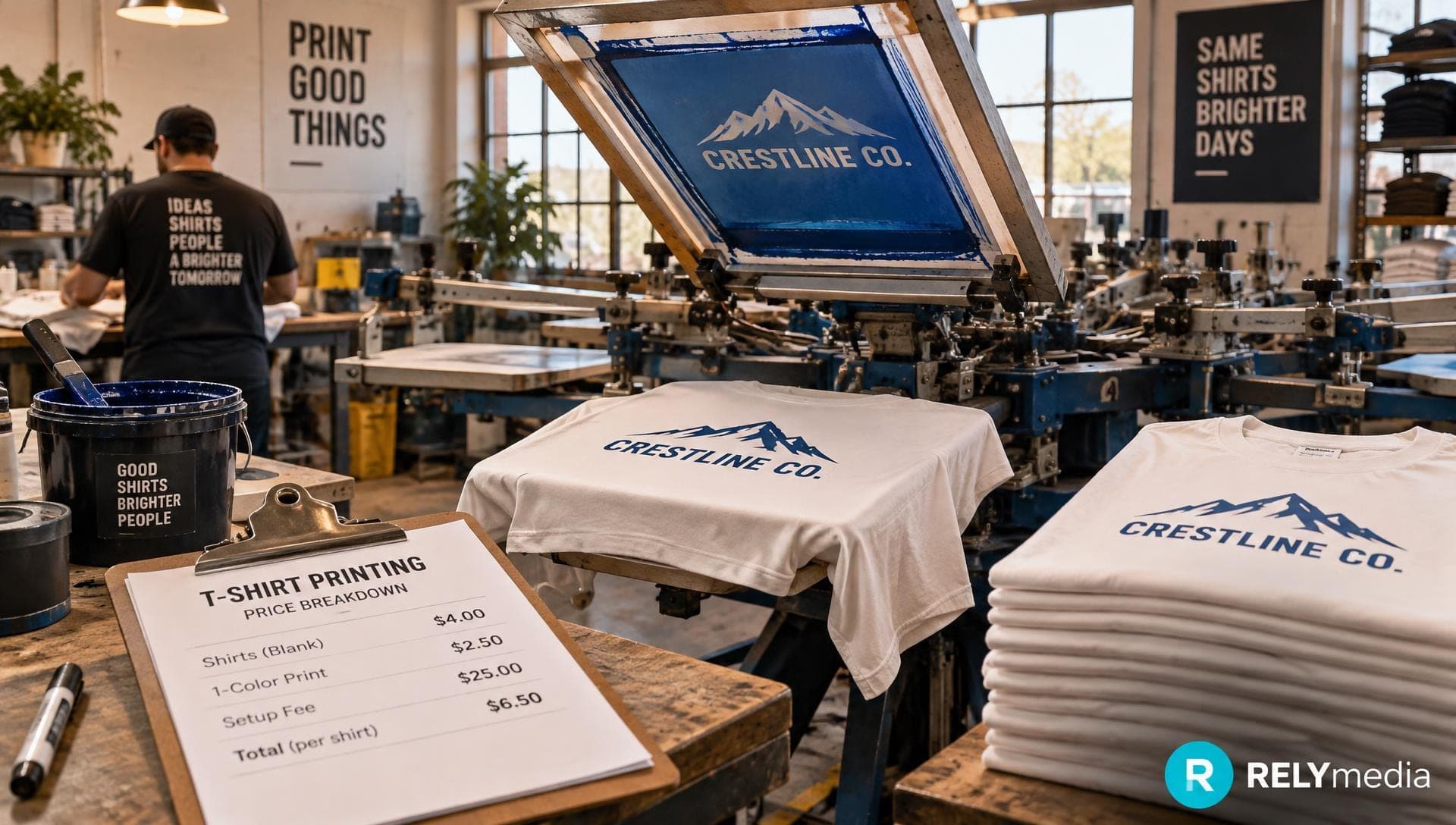
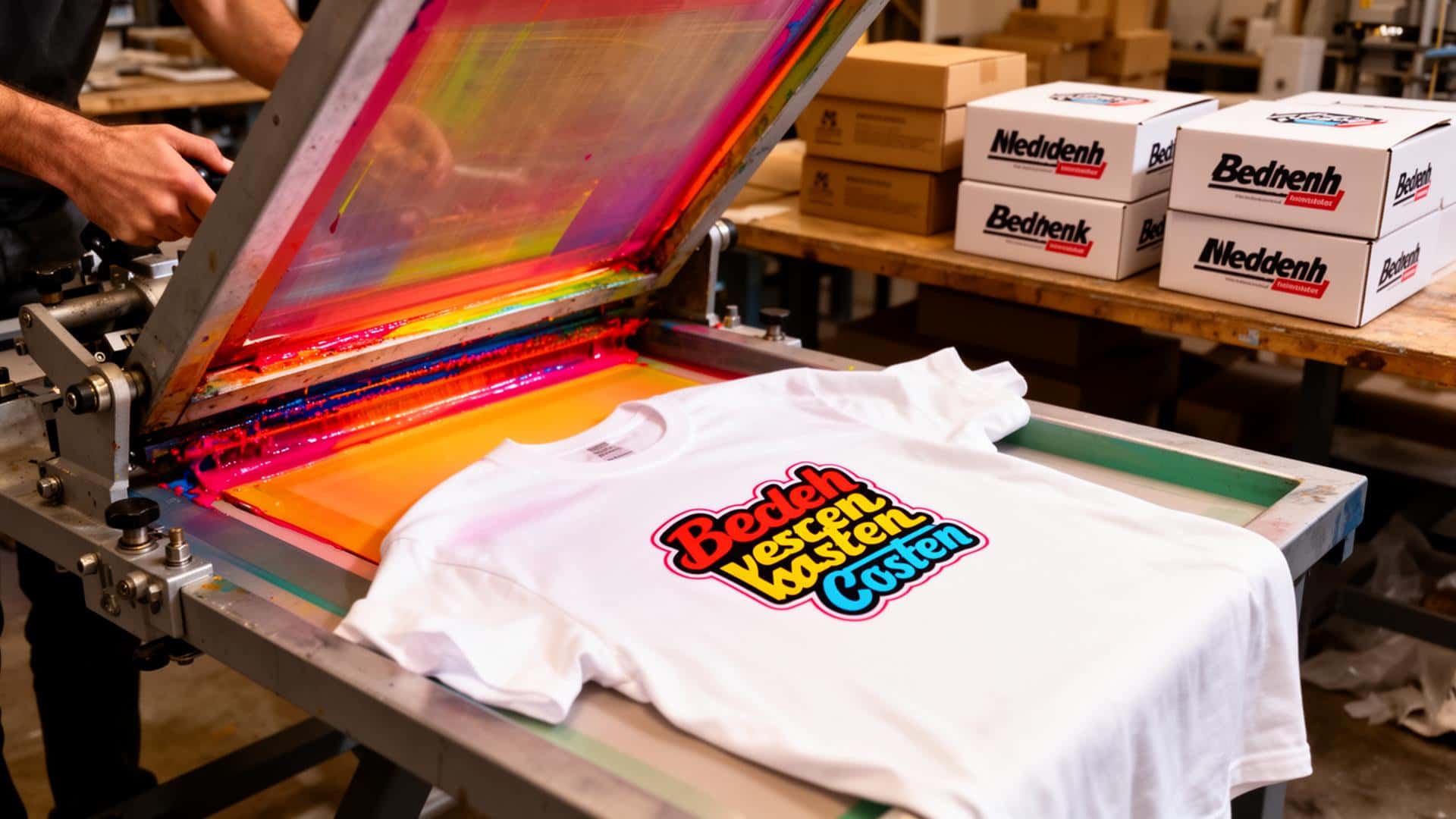
Screen printing (also called silk screen printing) pushes ink through a fine mesh screen onto the shirt. A stencil on the screen blocks the ink everywhere except your design. Each color in the design needs its own screen.
- 1. Separation: the artwork is split into one layer per ink color.
- 2. Screens: each layer is exposed onto a mesh screen coated with light-sensitive emulsion, which leaves an open stencil of that color.
- 3. Setup: the screens are lined up on the press so the colors land in register.
- 4. Printing: a squeegee pulls ink through each screen, one color at a time.
- 5. Curing: the shirts go through a conveyor dryer so the ink cures and bonds.
What Plastisol Ink Actually Does
Most shirt printers use plastisol ink. It does not soak into the cotton. It forms a layer that sits on top of the fabric and grips around the surface fibers, and heat fuses it in place. Blue Cotton's comparison of the two main inks puts it simply: plastisol sits on top of the fabric, while water-based ink soaks into it. That is why a plastisol print looks bright and opaque and has a slight raised feel.
Curing matters. Ryonet's ScreenPrinting.com notes that most textile plastisol cures in the range of 300°F to 330°F, and the whole ink layer has to reach that temperature. Under-cured ink can crack or wash off; a correctly cured print should last as long as a normal shirt.
Screen printing suits bold, clean designs with a limited number of solid colors. If your artwork is a photo or full of gradients, look at DTF or DTG first.
Screen Printing vs DTF vs DTG vs Sublimation
| Feature | Screen Printing | DTF (Film Transfer) | DTG (Direct-to-Garment) | Sublimation |
|---|---|---|---|---|
| How it works | Ink through a screen, one per color | Design printed on film, then heat pressed | Inkjet prints straight onto the shirt | Dye turns to gas and bonds with polyester |
| Best for | Larger runs, a few solid colors | Small runs, full color, mixed fabrics | Small runs, full color on cotton | All-over prints on white or light polyester |
| Setup | Screens for each color | None per color | None per color | None per color |
| Cost per shirt as quantity grows | Drops steeply | Stays fairly flat | Stays fairly flat | Stays fairly flat |
| Fabrics | Cotton, blends, many others | Cotton, polyester, blends | Mostly cotton | Polyester only |
| Feel | Ink layer you can feel | Smooth film layer | Soft, ink in the fabric | No feel, dye in the fiber |
Screen Printing or DTF?
DTF (direct to film) is the main alternative for small orders. The full design is printed onto a clear film, coated with an adhesive powder, cured, then heat pressed onto the shirt. There are no screens, so a 10-color design costs the same as a 1-color design, and it works on cotton, polyester and blends.
- Choose DTF for small quantities, photos or many colors, or when every shirt has a different name or design.
- Choose screen printing for larger runs of the same design in a few solid colors, where screen setup spreads across many shirts.
- The crossover depends on the number of colors and locations. Ask for both prices on your actual design and quantity; the more shirts and the fewer colors, the sooner screen printing wins.
DTG is the other digital option. It prints ink straight into the fabric and gives the softest feel on cotton, but it is slower per shirt and works best on high-cotton garments. Sublimation only works on white or light polyester.
Screen Printing Inks: Plastisol, Water-Based, Discharge and Specialty
| Ink | How It Sits | Good For | Limits |
|---|---|---|---|
| Plastisol | Layer on top of the fabric | Bright, opaque color on almost any shirt color | Heavier feel; PVC-based |
| Water-based | Soaks into the fibers | Soft prints on light cotton | Less opaque on dark shirts; weak on high-polyester |
| Discharge | Removes the dye, then adds color | Soft prints on dark cotton | Only on dischargeable cotton dyes, not polyester |
| Specialty (puff, metallic, glitter) | Varies | Raised or shiny effects | Usually cost extra; need specific mesh |
Water-based and discharge inks avoid PVC, which is why printers market them as the greener option. On tri-blends and high-polyester shirts, ask what ink the printer plans to use: water-based ink absorbs poorly into synthetic fibers, and discharge does not work on polyester.
Mesh Count Guide
Mesh count is the number of threads per inch in the screen. Lower counts let more ink through (good for thick inks and bold shapes); higher counts hold finer detail. These starting points come from Ryonet's mesh count guide:
| Job | Mesh Count |
|---|---|
| Glitter ink | 36 (up to 64) |
| Shimmer ink | 86 to 110 |
| Block letters, thick white plastisol (little detail) | Below 156 |
| General plastisol | 156 |
| Water-based ink | 180 to 230 (as low as 156 with experience) |
| Fine lines, standard halftones, printing over a white base | 156 and above |
| High detail, soft-hand plastisol | 200 to 305 |
| Simulated process, wet-on-wet, high detail | 230 and above |
Treat these as starting points. The ink maker's technical sheet for the exact ink is the final word.
Choosing the Right Shirt for Screen Printing

| Fabric | How It Prints |
|---|---|
| 100% cotton | The easiest fabric to print. Works with plastisol, water-based and discharge inks. |
| Cotton/polyester blends | Print well with plastisol. Water-based ink is less vivid on the polyester part, and dye can migrate into light inks on some blends. |
| Tri-blends | Very soft, popular for retail-style shirts. Usually printed with water-based or low-cure plastisol; discharge does not work on the polyester content. |
| 100% polyester | Needs low-cure inks made for polyester. For all-over or photo prints on white polyester, sublimation is often better. |
For specific blanks, weights and style numbers, see our comparison of the best t-shirt brands for company apparel.
What Drives the Cost of Screen Printing

Every screen printing quote is built from the same pieces. Knowing them lets you compare quotes fairly and trim cost without changing the look much.
- Quantity: screens and setup cost the same for 24 shirts or 500, so the price per shirt falls as the order grows.
- Number of colors: each color is another screen and another pass. A dark shirt may also need a white underbase screen.
- Print locations: a back, sleeve or second side print is a new setup with its own screens.
- The blank: premium soft-style shirts cost more than basic heavyweight cotton, and 2XL and up usually cost more than standard sizes.
- Specialty inks and rush: puff, metallic and glitter inks, and rushed deadlines, usually add to the price.
Because setup is a fixed cost, most screen printers set a minimum order. For a few shirts, DTF or DTG is normally the better value. For price ranges by quantity and method, see our guide to how much custom t-shirts cost.
What Affects Turnaround
Proof approval
Production starts once you approve the mockup, so a fast reply saves days.
Order size
Larger orders need more press and dryer time.
Color count
More colors mean more screens to make and register.
Season
Spring and fall are busy for school, sports and event shirts.
Preparing Artwork for Screen Printing
- Send vector art (AI, EPS, SVG or a PDF with outlined text). A high-resolution PNG at print size, 300 DPI, is the fallback.
- Count your colors: fewer spot colors means fewer screens. A one-color version of your logo is often enough.
- Give PMS numbers for brand colors so the printer can mix the ink. Our guide to imprint colors explains how colors are counted.
- Avoid hairlines and tiny text. Very thin lines can close up or break on lower mesh counts.
How to Make Screen-Printed Shirts Last
- Turn shirts inside out before washing to protect the print from abrasion.
- Wash in cold water and skip harsh detergents and bleach.
- Air dry or tumble dry on low heat.
- Never iron directly on the print. Iron inside out or put a cloth between the iron and the design.
Checklist for Choosing a Printer
Itemized quote
Setup, per-shirt price, extra colors and locations shown separately.
Digital proof
A mockup with print size and placement before production.
Ink and mesh plan
A clear answer on which ink they will use on your fabric.
Blank choice
Several brands and weights, with the style numbers named.
Browse Custom T-Shirts
Pick a blank, then send your artwork and quantity for a screen printing quote.
Ready to put your logo on screen-printed tees?
Fill in your details and a RELYmedia specialist will come back to you with a custom quote. Fast turnaround, no obligation.
- ⚡Same-day response on business days
- 🎨Free design assistance included
- 🚚Rush order & fast delivery available
- 💰Price beat guarantee on every order
Shop custom t-shirts
See all custom t-shirts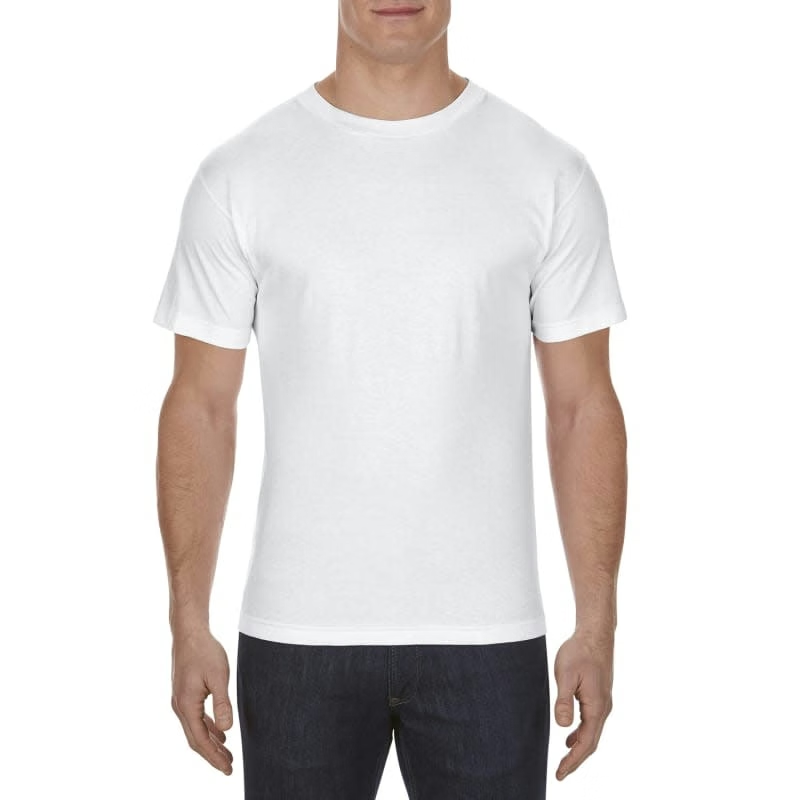
American Apparel Unisex Heavyweight Cotton T-Shirt
$8.90 - $10.90
View product
Custom Adult Unisex Cotton Short Sleeve T-Shirt MOQ 10pcs
$2.67 - $9.01
View product
Bella Canvas® Unisex Cotton T-Shirts
$9.44 - $10.73
View product
Cotton T-Shirt: Gray
$20.00
View product
Cotnwell Men's Full Color 180g 100% Cotton T-Shirt
$5.23 - $8.27
View product
CloudHuggie Youth Full Color 230g 100% Cotton T-Shirt
$6.88 - $10.89
View product
Best Seller Custom Cotton T-Shirts - Men's & Ladies
$3.21 - $4.78
View product
Cotton T-shirt
$6.65 - $8.91
View product
Frequently asked questions
Is DTF or screen printing better?
It depends on quantity and colors. DTF has no screens, so it suits small orders, full color art and different names on each shirt, and works on cotton, polyester and blends. Screen printing wins on larger runs of one design in a few colors, where the setup cost is spread across many shirts. Ask for both prices on your real design and quantity.
Does plastisol ink soak into the shirt?
No. Plastisol forms a layer that sits on top of the fabric and grips the surface fibers once cured, which is why it looks opaque and has a slight raised feel. Water-based and discharge inks are the ones that go into the fibers.
What mesh count should I use for screen printing shirts?
Ryonet’s guide gives 156 as a general standard for plastisol, 180 to 230 for water-based ink, 200 to 305 for soft-hand plastisol and 230 or higher for fine detail and simulated process. Thick inks like glitter need much lower counts. Check the ink maker’s technical sheet for the final word.
Can you screen print on polyester and tri-blend shirts?
Yes, with the right ink. Polyester needs low-cure inks made for synthetics, and tri-blends are usually printed with water-based or low-cure plastisol. Discharge ink does not work on the polyester content.
How many colors can a screen-printed design have?
As many as the press has stations, but every color adds a screen, setup and a pass on each shirt. Most shirt designs use a few spot colors; for photos or many colors, DTF or DTG is often cheaper.
What file format should I send for screen printing?
Vector art such as AI, EPS, SVG or a PDF with outlined text. A high-resolution PNG at print size and 300 DPI is the fallback. Give PMS numbers for brand colors.
Is screen printing eco-friendly?
It depends on the ink. Plastisol is PVC-based, while water-based and discharge inks avoid PVC, so printers often offer them as the greener option. Ask which inks the shop uses and how it handles screen cleanup.
Shop this
Need screen-printed tees? We print them.
Bulk pricing, three free mockups, real quotes back the same business day.